Showing posts with label Wildlife Photography. Show all posts

Wednesday, July 6, 2011

Overheard...

(Customer comment at a recent art show...) 
"That would be a good one to have right across from your toilet - that guy laughing at you!"
'Good One!'
(c) John Ashley
"That was a good one!" (c) John Ashley

Saturday, June 4, 2011

New work: "Bighorn Brotherhood"

“A portrait is not made in the camera but on either side of it.” (Edward Steichen)
'Bighorn Brotherhood' (c) John Ashley
"Bighorn Brotherhood" (c) John Ashley
I enjoy customer compliments, just like everyone else. But what I love about this job is when a wild animal chooses to allow me into his personal space. It's sort of like saying, "You're okay, so I'm going to ignore you now and do whatever I would be doing if you weren't here." Whenever this happens, it always makes those moments - and the resulting images - stand apart from when the animal considers you a potential threat. Animal behavior can be a subtle thing, but sometimes those nuances can show through and render the camera invisible.

Thursday, February 17, 2011

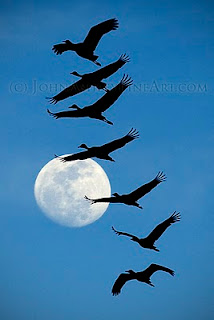
Sandhill Cranes -- by day and by night

"Cranes carry this heavy mystical baggage. They're icons of fidelity and happiness. The Vietnamese believe cranes cart our souls up to heaven on our wings." (Mitchell Burgess) 

Let's begin by reminding everyone to NEVER look directly at the sun through your camera! Even a medium lens is enough focal power to fry your retina. Only a dimwit would aim a fat telephoto lens at the blazing sun -- so let me tell you how I did it.

Sandhill Cranes (c) John Ashley
Sandhill Cranes flying across the sun (c) John Ashley
I came to this Arizona wetland last winter to photograph Sandhill Cranes. We spent two evenings running around the desert to line up a flock cranes with the rising moon. It was harder than I expected. This year, capturing cranes against the sun turned out to be easier than expected -- but I still had to scout for two days to find the best location.

First, a 500mm lens attached to the D700, a cable release attached to the camera, and everything anchored to the tripod. Aiming slightly to the right of the sun, I prefocused on the expected flight path. (Hint -- it isn't infinity. That would be too easy.)

Now for the "trick." I set the D700 to "live view" and, watching the live image on the rear LCD screen, I can safely aim the camera directly into the sun. Now I just have to shield the sun with my left hand and, when the flock approaches the inferno, fire away with the remote release.

Moonlight Flight (c) John Ashley
So I never actually see the birds cross the sun. And, if their path takes them across the center of the sun, then those few birds usually just dissappear from the image. Buts the sun's constantly moving, and the birds will fly higher and lower, nearer and farther away, so it's still a matter of luck and patience.

If it's early (or late) in the day, and there is a significant amount of thin clouds, fog, or whatever, then these will act like a neutral density filter and knock the sun back for you. Plus, you'll get a nice, sharp edge around the sun. But the sun is going to roast your image on a clear day. For days like this, the camera's ISO is set as low as it will go, while aperture and shutter speed are as high as they will go.

(Side notes: I almost always shoot wide open, so I seldom have problems with dusty sensors. Stopping the lens all the way down, however, was an ugly, ugly awakening. Also, stopping down past about f8 increases diffraction and decreases sharpness. In this sun example, however, soft focus can actually add to the images' "feel.")

Both images are simple compositions of cooperative Sandhill Cranes. But the mood of each image is as different as, well, day and night.


Tuesday, January 25, 2011

Raising Arizona

"Aristotle was famous for knowing everything. He taught that the brain exists merely to cool the blood and is not involved in the process of thinking. This is true only of certain persons." (Will Cuppy) 

Wasn't that the title to a bad Nicolas Cage movie? I'm staggering back from a 3- or 4-day migraine, I lost count. Just a few hours of real sleep this week. All of my recent thoughts and memories are chopped up and blended together, just a confusing bunch of snippits so far.

I remember getting ready for a reunion this weekend, "raising Arizona" with a bunch of friends. Then there's this recollection of another friend taking his photo show on the road, complete with strobe lights like the rock band, "Electric Light Orchestra" (anyone remember them?) or something; 29 cities in 42 days -- wish I could make one.

And I distinctly remember sitting in a little restaurant with a dear old friend whom I've never met before, talking about Mexican jaguars and global warming. I can also remember camping in the Arizona desert for three nights to get the appropriate moonset image in a magical location. Failed. Got lots of good images, but nothing that does the place justice. Next full moon...

Female Anna's Hummingbird (c) John Ashley
Female Anna's Hummingbird, 105mm, f 9.5, 1600 ISO, 50% crop
In the middle of all this, I'm also test-driving a lens from my friend, Bob. A Nikon 105mm 2.8 micro. Nice lens. I put it to the test on a cooperative, free-ranging hummingbird. It's hard enough to get sharp macro images of slow-moving bugs and such. Capturing hummingbirds with less than 1/2" depth-of-field was downright humbling.

I don't normally photograph "feeder birds." But I figured it would be a good challenge for the lens. The bird's attracted to a little test-tube filled with sugar water, attached with a suction cup to our reflective camper window (ie - fill light). She's a little Anna's Hummingbird, and she can kinda' sorta' see me inside, so I can't move.

Manual focusing scared her off. So I put the autofocus square on her eye, and pressed halfway down on the shutter when she turned broadside -- which never lasted more than a split second. That put her eye in sharp focus and gave me just a touch of blurry beak. Way too much blurriness when she pointed towards me.

That much I remember. Now I'm just hoping this migraine, and my medicine-induced blurriness, both go away by morning. I've got an early 8-mile work hike [turned out to be 11 miles] with a 72-year-old man who would leave me in the Arizona dust, even on a good day.


Thursday, January 6, 2011

The Eyes Have It

"Life is the movie you see through your own eyes. It makes little difference what's happening out there. It's how you take it that counts." (Dennis Waitley)

Desert Eyes (c) John AshleyThe Smithsonian National Natural History Museum in D.C. is on my bucket list, and has been for many years. But for now, the Arizona-Sonora Desert Museum near Tucson is my all-time favorite. From a trip there a few days ago, I put together a little reminder about what is probably the most important rule in wildlife photography. I'll give you a hint -- it has to do with eyes.

If your subject's eyes are visible, they should be tack-sharp in 99% of all situations. There's probably 1% of times when you can break this rule, but I can't think of a single example at the moment -- that's how rare it is for a good photograph to have blurred eyes visible.

Recognize anyone in the photo? Here's a few hints. There are 14 birds and a mammal, a fish, a reptile and an amphibian. Among the birds there are three different owls, a hawk, a falcon and a hummingbird. Some of these are pretty hard. If you can identify half, then you're doing pretty good. If you get more then half, you are a biologist -- go back to work.

Give up yet? Answers below.

From top left to bottom right: Harris' Hawk, unidentified fish, White-winged Dove, black-tailed prairie dog, Scrub Jay, lizard, Costa's Hummingbird, Great-horned Owl, parrot, Screech Owl, Barn Owl, Black-necked Stilt, Band-tailed Pigeon, female Cardinal, Prairie Falcon, frog.

.

Sunday, March 14, 2010

Wanted: Mega-monopod

"Ethics is knowing the difference between what you have a right to do
and what is right to do."
(Potter Stewart)


Dear Ms. Manners,

My wife and I both pretty friendly. We love fuzzy animals, help elderly people cross the street, and do lots of community service. We have a little photography business that we work very hard at. My question is this, when I’ve spent a long time easing into position to photograph a shy bird, and someone with expensive camera equipment stumbles up behind me to take pictures of the same thing, but scares all of the birds away instead, is it wrong to beat him senseless with my telephoto lens?
-- Sincerely, Slightly Bent Out of Shape


Dear Slightly Bent,

I feel your frustration and I can tell that deep down you are a generous soul, and rather handsome to boot. But it would be wrong to beat this person with your camera lens. The business end of your monopod would be much more effective, and substantially less expensive. You obviously work hard for your money, but if you can afford a nice, heavy ball head, so much the better. Give it a try next time and, please, let me know how it goes. I care.   
-- Good luck, Ms. Manners


                   -----------------------------------------------------------------

While driving our diesel-gulping truck camper a couple of weeks ago, all the way from southern Arizona to northern Montana, I passed a grand total of two cars and three semi trucks (yes, I counted). Based on this rigorous statistical analysis, there are approximately five people between Mexico and Canada who are more mild-mannered than me.

Apparently, they aren't photographers.

Aggression is a basic personality trait that reveals itself in degrees. While photographing birds on our Arizona trip, Tracy and I encountered lots of photographers -- most were considerate, but it wasn't always pretty. (Or maybe the four guys below were "picture takers." These days, most of the people walking around with expensive camera equipment are retired amateurs, not photographers working for a living.)

Sandhill Cranes and the full moon (c) John AshleyThe first guy was polite. We stumbled across him near a wooded trail that winds along a lakeshore. We waved silently to each other, and then Tracy and I slipped around him so we wouldn't disturb whatever it was that he was photographing. He saw our camera gear, but he didn't follow us.

This guy was the green farm truck that waves as it passes you, the one that pulls over to the side of the highway before making a phone call.

The second guy was slightly annoying. He was weilding a big Canon lens at a small desert pond full of ducks, where Sandhill Cranes return on winter evenings to spend the night. I had waited three years to return to this spot to attempt a photograph of the returning cranes against the full moon -- one of those ideas that gets stuck in my head and won't leave me alone.

Tracy and I were moving through the desert scrub together, a quarter-mile at a time, trying to align the scattershot cranes with the ever-moving moon. Looking back, we realized that Big Canon was following us. Looking at ourselves, I was wearing brown cammo but Tracy was wearing a red coat. Big Canon had spotted us from half a mile away, figured out what we were up to, and decided to join us. Fortunately, he stayed 100 yards back and didn't affect the birds we were trying to photograph.

This guy was the black sedan that rides your bumper, tailgating at 65 mph because he thinks you'll increase his gas mileage. Annoying, but not a big deal.

foraging Arizona Woodpecker (c) John AshleyThe third guy was clueless. Tracy and I were hiking into a wooded creek bottom of a popular, birding hotspot. Standing in the middle of my route, a fellow wearing about $20,000 worth of camera gear was working something in the trees. So we detoured quietly around Mr. Rich, circled behind him unseen and moved off several hundred yards into the woods. Well out of view, we started working with a mixed flock of interesting birds. An Arizona Woodpecker and Painted Redstart were feeding alongside a few more common birds.

After some time, the birds began to ignore our presence, feeding below eye level right in front of us. I was carefully working towards a clean background for the Arizona Woodpecker when I heard crunching noises behind me. Suddenly all of the birds flew high up into the tree tops, and I turned around to find Mr. Rich stumbling around a few feet behind us.

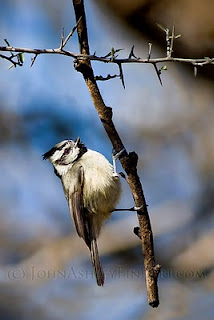
Bridled Titmouse foraging in thorny tangle (c) John Ashley
"Tracy. We have an interloper!" I spoke much louder than necessary, hoping the guy would get the hint.

No such luck. Mr. Rich refused to respond or even look at me, and was pointing his big lens almost straight up into the bright sky -- more than enough evidence that he was taking crappy pictures. I gathered my gear in a huff and hiked away into a mesquite bosque, where we enjoyed a flock of Bridled Titmouse in peace.

This guy was the yellow Hummer, passing in the no-passing zone, the one who forces you off the road as he casually swerves into your space just before causing a head-on collision.

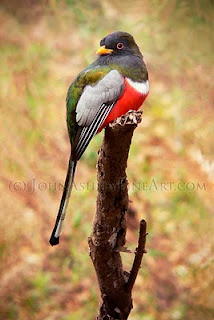
But the forth guy was the worst. We were enjoying a guided hike with about a dozen happy birders with binoculars. A 60-ish guy with average camera gear walked straight into the middle of our group, interrupting the guide to tell everyone about his photos of an Elegant Trogon -- one of the local birds that we hadn't seen that morning. "I spent hours with him," he boasted. "Got hundreds of pictures. I bet that just makes you feel sick!" I couldn't believe my ears. We'd seen the Trogon a few days earlier -- completely surrounded by cameras -- and we just walked away quietly.

male Elegant Trogon (c) John Ashley
This guy was the red sports car driven by a trust fund teenager, the one who passes you without bothering to move out of your lane, both of his right tires on your side of the painted line.

You know the one.

Letting these guys get under my skin is just one of my many character flaws, I guess. Most people would just blow off these idiots and keep on photographing. I couldn't. I had to leave.

I'm not an aggressive photographer, not one of the "trophy hunters." Getting the rare, good image is invigorating, encouraging. But spending my time respectfully in wild places, with wild creatures, is my reward.

For me, photography is a meditation. Sort of like a quiet Sunday drive on a forgotten backroad to clear your mind. I enjoy the company of a friend or two, but if some aggressive hitchhiker pushes his way into the car, it ruins the experience.

Non-aggressive types like me tend to just walk away and avoid conflict. But the numbers of people carrying cameras is growing exponentially, and you can't teach ethics to some of these guys -- it just isn't a part of their personalities. At this pace, these people with aggressive tendencies will come to dominate most of the hot spots. Bosque del Apache has turned into a photographer freeway, and Yellowstone is not far behind. What's the point in standing in a crowd, capturing the same image as everyone else? I just don't get it.

How will considerate photographers adapt? As for myself, I'll keep searching out isolated backroads. And, I'm also saving up for a big, heavy ball head for my monopod.


Saturday, October 17, 2009

Photographs and Memories

"When I was younger, I could remember anything, whether it had happened or not. (Mark Twain)

While writing a recent issue of "Wild & Free Montana," a mental image fell out of a cardboard box in some dark, dusty corner of my memory. That issue was about photographing animals at eye level. And the mental image reminded me of an, um, interesting photo assignment that I had completely forgotten about -- the one where I was almost mauled by a cougar that had wrapped itself around me. Maybe I should explain.

Remember the Lincoln Mercury ad campaign back in the early 80's? It featured a cougar reclining on top of their sign, growling and twitching its tail. I was working for a newspaper in central Florida, and it was a local family that raised those cougars (yes, they had more than one). Car shows and dealerships around the country would hire these guys to parade a cougar around on a chain for the weekend. It was an event -- people got to see a "scary" animal, and this family got to make a living.

But then, up in some northeastern state, the cougar mauled a kid who got closer than he was supposed to. An off-duty cop shot the cat, and the kid survived. And that's when my newspaper entered the fray.

Back in Florida, the mauling story pounded out of the bulky Associated Press teletype machine and landed in the copy editor's hands. This was back in pre-history (1982) and my memory is pretty blurry. But somehow the editor added some copy to the AP story that potentially slandered the cougar's owners. Bad day for the kid, bad day for the cougar, and bad day for my employer.

The family met with the publisher and threatened to sue. Over the course of several intense meetings, they came to a tenuous agreement. The lawsuit would be dropped if the paper published a feature story that was "positive" about the family and how well-treated and safe their animals were.

Guess who got sent. It should have been that copy editor, but it wasn't. Instead, they sent a perky young woman reporter and me. Actually I had read all about the rare Florida panther and was curious to see a captive cougar up close.

(My prints from that day are long gone. But they had a menagerie of other big animals as well, and I do remember that the photo most popular with the editors showed a Bengal tiger swimming with its buxom woman owner in a wet t-shirt. Some things never change.)

But back to the cougar. While the reporter was busy interviewing the guy, I slowly approached the cougar and started taking pictures. The big cat was calmly laying in tall, green grass on what looked to be about 20' of chain, and the chain was anchored to a big steel stake in the ground. His tail started twitching slowly.

You see where this is going, don't you?

Photographing a cougar from a standing position makes it look smaller, like a house cat. So I dropped down closer to eye level for better photos, and crouched left, right and forward. All of my attention was focused through the lens, and I felt pleased that the cougar was now staring at me, eye-to-eye.

Then I stood up.

The cougar was on me, mouth at my neck, front legs wrapped around my shoulders, before I made it off the ground.

Now if you freeze the frame here and ponder the situation, the first thing that comes to mind is, HOW STUPID ARE YOU? The next thing is, how should one react in that situation? If it was a wild mountain lion, you would try fighting it off. But this was a trained cat, raised in captivity. What would you do?

I froze.

Camera slung over one shoulder, camera bag dangling from the other, and a 140-pound cougar draped in my arms. In my mind's eye, I can no longer see what happened immediately before or after. But I can clearly see myself standing there, hugging this cat, frozen in time and in place like an old black and white photo that you haven't looked at in years.

Almost as fast as the cat, the owner charged into the cougar and smacked it with a short length of chain. The cougar pushed off me and lept back into the grass. I slowly backed away and surveyed the damage. I didn't have a single scratch. But the cat got wailed on, and the reporter was suffering from a serious case of eye-popping.

It was an awkward moment, given that we were there to write a "positive" story about how safe these animals were. But we were supposed to be professionals, so by the time we had driven an hour back to town, we were able to play it down and dismiss what might have happened. Still, as word slowly leaked out around the newsroom, I think the reporter and I gained some stature. We did our jobs, after all, and no one got hurt and no one got sued.

They got their story, and I got one of my own. It's one of those old, fading images that you store in a box in some dusty corner, until you forget that it's even there.

Friday, April 17, 2009

Studly Ducks

"Use what talents you possess: the woods would be very silent if no birds sang there except those that sang best.” (Henry Van Dyke)

Harlequin Duck (c) 2009 John Ashley[ Note: This is a recent article that I wrote for the local Audubon chapter newsletter and local newspaper. Place names are western MT locales. ]

There are only two serious contenders for the most dazzling duck in western Montana. The male Wood Duck and male Harlequin Duck are easily our most decked-out waterfowl. But other than looking outrageously handsome, there are surprisingly few similarities between these two Montana natives.

Trying to describe the feathers on these fellows is like trying to describe a box of crayons. A male Woody wears iridescent emerald head feathers, a white polka-dotted mahogany breast, and smooth almond flanks. The male Harley sports a midnight-blue body, chestnut flanks, and white patches that vary in shape from round to crescent. The females and young of both species are mottled brown, and the female Woody wears a striped, white eye patch while the Harley hen has a round, white cheek patch.

Think of these two smallish ducks as Montana’s “common cosmopolitan” and “rare recluse.” While Woodies are pretty common in summer, Harleys are twice as rare as grizzly bears. Woodies spread out across most riparian habitats, but they prefer the slow waters of beaver ponds, creeks and oxbows. Harleys are just the opposite. They spend the nesting season on just a handful of fast-flowing Montana streams, though they’ll occasionally show up on lakes and rivers during migration.

male Wood Duck (c) 2009 John AshleySome Woodies stick it out and stay in western Montana year-round. But starting in early April, most of them migrate up from southern California and Mexico. Harleys, on the other hand, migrate east-west, and begin arriving in Montana by late-April from the Pacific coastlines of Oregon, Washington and British Columbia.

Woodies nest almost exclusively in tree cavities, with a strong preference for naturally occurring holes. They don’t do any excavating, but they will occasionally use old Pileated Woodpeckers cavities. They’re also quick to move into man-made nest boxes, when properly sized and placed. Countless Woody nests have been documented, and the nest trees might be located half a mile or more from the nearest body of water. Not so with Harleys. They are almost exclusively ground nesters, and most Harley nests are well-hidden within just a few feet of the water’s edge. They are incredibly secretive while nesting. In Montana, you can count the number of reported nests on one hand -- and still have a couple of fingers left over.

Female Woodies will often nest as yearlings, but most female Harleys won’t even attempt to nest until they are 4-5 years old. While some of the Woody hens return to nest in the same wetland where they were born, pretty much every Harley female returns to her natal stream for nesting. Woodies lay twice as many eggs (10-15) as Harleys (5-7), and some Woodies even manage to raise two broods in a summer. Harleys never attempt more than one nest per year.

Once the females start incubating eggs, the males of both species leave the nesting area and do not help with raising the young. Once apart from their mates, the adult males of both species will molt their colorful breeding feathers and wear a more female-like plumage for rest of summer. Male Harleys migrate back to the coast in early summer, before the eggs even hatch.

The eggs of both species hatch after about 28-30 days of incubation, usually in late June and July. Both species are precocial, so mom will guard her chicks but she won’t feed them. All of the downy chicks start out eating aquatic insects, but after about two weeks the young Woodies begin a gradual change-over to the mostly vegetarian diets of their parents. The Harleys will stick to a carnivorous menu.

Juveniles of both species are able to fly at about 6-8 weeks old. Their first set of real feathers -- for young males and females alike -- will look a lot like their mother’s plumage. The young Woodies will eventually wander away from mom while learning to fly. They’ll disperse in all directions before turning south for migration between mid-September and early November. Here in Montana, most of the young Harleys will get left behind on the natal streams when their moms migrate back to the coast in August or September. A month or two later, the young Harleys somehow know to migrate west to a place they’ve never been before. They will end up on the same rocky coastlines with the adults, but they won’t reunite with their parents or siblings.

Woodies are monogamous during a breeding season but can change mates from year to year. Once paired, Harleys mate for life. Harley pairs reunite on the coast and spend their winters together, and in the spring they arrive in western Montana together.

Spring is by far the best time to look for both of Montana’s most handsome duck species. The more common Woodies can be spotted in many local waterways, including Spring Creek, Ashley Creek and McWenneger Slough. But the easiest place to see them is Woodland Park in downtown Kalispell. Just about the only way to see the rare Harleys in spring is to drive as far as you can up the Going-to-the-Sun Road in Glacier National Park, then park your car and hike or ride a bike even farther. Keep a keen eye on the swirling waters of McDonald Creek, and prepare to be dazzled.

Monday, April 6, 2009

Spring in Bits & Spurts

"If we had no winter, the spring would not be so pleasant: if we did not sometimes taste of adversity, prosperity would not be so welcome.” (Anne Bradstreet)

Our calendar flipped past the first day of spring and right on into April, but the snow berms still looked the same around our house. So after five straight days of snow and dull gray skies, we made a deal. If Tracy finished with the taxes that she’s been avoiding, and if I finally finished grouting the tiles that I had laid weeks earlier, then we would take a whole day off to go searching for signs of spring.

road-tripping dog (c) 2009 Tracy SchiessThe forecast called for sunshine, and the sky was full of stars when we lifted our old dogs into the car before dawn. We quickly dropped in elevation and headed south toward the far end of the Flathead Valley. We weren’t in a big rush, but Highway Patrol Officer Denton did turn around just to visit with us and suggest that we slow down. Because of this, the sun peeked over the mountains before we were halfway there. After a few golden moments, the sun climbed into a growing bank of clouds. As the coffee started kicking in, I realized that the clear sky was fading in our rearview mirror, and we were driving into the gray curtains of snow clouds. Big, wet snowflakes – our first sign of spring.

Tundra Swans (c) 2009 John AshleyWe were aiming for the National Bison Range, but a small group of Tundra Swans flew past our windshield and lured us onto the muddy back roads of Ninepipes National Wildlife Refuge. The main reservoir had iced-out and assorted ducks and geese were spread across the water. On a small island, four Bald Eagles studied the ducks from their perch in an old, gray cottonwood snag. On the adjacent island, another old cottonwood had finally fallen down, and the entire island was covered with noisy gulls staking out gravel for future nest sites.

The government built the two islands thinking they would make great duck nesting habitat, but the gulls and Cormorants promptly took over. Once when I was in college, I helped count and age all the gull eggs on those islands, and we had to wear full raingear to protect us from the gull’s best defense – non-stop guano bombing runs, with us as moving targets. Now I’m supposed to be older and wiser, so I appreciated the gulls’ tenacity from the warmth and safety of our car.

Pronghorn Antelope (c) 2009 John AshleyOnce again, we drove towards the Bison Range only to be lured away by birds. We pulled off into the mud and let the dogs out to stretch. On one side of the road, a Short-eared Owl sat on a post in the middle of the field. On the other side, about 500-800 Northern Pintails were feeding in last year’s fallen brown grasses. Every five minutes or so, someone in the group would decide to try elsewhere, and half the flock would circle the sky for a minute or so before landing again within duck-walking distance of where they started.

Things were much quieter when we finally reached the Bison Range. Small groups of white-tailed deer ignored us from the creek bottom, and the bison were little brown dots way up on the hillside, just below snowline. A group of pronghorn does and yearlings worked the middle hills while a lonely buck grazed single-mindedly down along the road. A Golden Eagle took notes from a power pole.

Western Meadowlark (c) 2009 John AshleyIt would have been almost silent if not for the Meadowlarks. The original megaphone must have been inspired by a Meadowlark. The male’s song hits you like it’s coming from three feet away, but after scanning and searching you finally find the yellow-suited virtuoso perched on a rock 100 feet away. Even if it’s still snowing, a singing Meadowlark means that you have found spring.

We also found some old friends who were out looking for spring, and they directed us to a birding hotspot back up near our end of the valley. We arrived at Church Slough to find hundreds of Tundra Swans and American Widgeon spread out on the far side of the river bend, where the ice had melted. We watched the show for hours as small groups of birds flew up and down the river.

sub-adult Bald Eagle (c) 2009 John Ashley At least one adult Bald Eagle and six sub-adults were also working the area and chasing each other around. Every so often, one eagle would make a slow pass over the ducks, low enough to frighten them into flying as a group. This way, the eagle could watch for any unusual movement that would signal a weak or injured duck. For efficiency’s sake, the eagle will usually only give chase if it spots an odd duck. Almost all of these inspection flights are unfruitful for the eagle. However, one eagle appeared to cause a bunch of duckly anxiety when it dove into a group of Widgeons -- and plucked out a fish.

The duck and eagle show was so entrancing that, the following afternoon, we drove back down to the slough for another round. Tracy spotted four of the eagles perched together on the ice, about half a mile downriver. But all of the ducks and swans had resumed their spring migrations, and I think the eagles were as disappointed as we were. But it was a sunny day, the first in recent memory, and the first warm day since last fall. And here in Montana, we’ll take our spring in bits and spurts if we have to.