Showing posts with label Photography Tips. Show all posts

Tuesday, February 22, 2011

Threading the Needle

This is my simple religion. There is no need for temples; no need for complicated philosophy. Our own brain, our own heart is our temple; the philosophy is kindness." (The Dalai Lama)

Planning a trip to photograph the moon on the horizon means that you need to know exactly where and when the moon will appear. I used to simply draw up a paper chart for each month – azimuths, rise and set times for sun and moon, etc. – and head out with my camera. Nowadays I use a lot of complicated technology, but sometimes the moon still surprises me and slips past.

Double arch seen from a distance (c) John Ashley
Double arch (center) as seen from across the desert valley
If you want to, say, photograph the moon rising inside a natural stone arch, the easiest option is standing close to and level with the arch. Up close, the moonrise is visible at a wide range of azimuths. But move the horizon above you 30 degrees, and lining up the moonrise starts to get complicated. Move back 100 meters and the arch starts to appear smaller relative to the moon, and they get oh-so-much harder to align. Now let’s double that distance to make the moon barely fit inside the opening and -- why not -- let’s also make the moon climb through two stacked arches.

Now that would be threading the needle. Do I even have a prayer, I wondered?

We recently learned of a double arch along a rough and rocky, one-lane road down in Organ Pipe Cactus Nat. Monument, along the Mexican border. We felt put off -- but not dissuaded -- by the Border Control checkpoints and the beehive of Border Patrol vehicles buzzing everywhere. Once while birding, an armed agent appeared in the middle of nowhere, and we later learned that we’d set off a buried motion detector. They also use airplanes and blimps, and early last night we watched a Border Patrol helicopter hovering low to spotlight a desert ridge. The boys were very busy.

So were we. Two days before full, the waxing moon would rise about an hour before sunset. Using our new Android-X phone, we triangulated a pretty good idea where the moon should appear by combining the applications for digital compass, data from “Moon Phase Pro,” and the “Google (night) Sky” map. All of this data was automatically fixed to our GPS location.

John watching moon through binoculars during interval photograph (c) Tracy Schiess
Monitoring moon's progress
during interval photograph
Still, I wanted to hedge my chances. So we backed up to the next ridge and started climbing.

Changing the angle up to the arches re-introduced some uncertainty into our plans. So I stood with camera at the location where I thought the moon would first be visible, and I sent Tracy down the ridge to the north, out of my view, giving us a wider view of the horizon, which we monitored with binoculars. Good thing.

Almost an hour after our vigil began, Tracy yelled, "HEY!," and I knew what she meant. “HEAD NORTH, DOWNHILL, FAST!” I ran with camera and tripod over grapefruit-sized volcanic rocks, over an unexpected six-foot cliff (where'd that come from?!), and down the ridge. I kept running until the moon was peeking over the bottom-left side of the arch opening, then started the intervolater to take images at 10-second intervals, and stepped back.

When Tracy reached me, I asked her to walk downhill to keep the rising moon in the lower left corner of the arch. When the moon cleared the upper arch from my position, I ran towards Tracy without having to track the moon -- another good idea. In this fashion, because we had a slope to work with, we were able to capture not one but three sets of images showing the moonrise through the arches.

In other words, we got lucky.

As the camera was capturing the last set of images, I asked Tracy one more favor. “You know, if you get the truck and meet me on the road, we might be able to catch the moon moving through Boulder Canyon. It’s only half a mile.”

Double Arch Desert Moonbow (c) John Ashley
"Double Arch Desert Moonbow" at 2.5 minute intervals (c) John Ashley
Tracy stopped in a cloud of dust and dropped me off when the moon reappeared from behind the stone cliffs of Boulder Canyon. I knew that the evening patrol was past due on the one-lane road. If another vehicle appears, I told her, just drive to the next wide spot and I’ll hike out to you. Then I moved off into the thick mesquite and massive boulders, looking for elusive images.

Not ten minutes later, Tracy's voice rang out again, “HEEEYY!”  Dang, another truck must be approaching. “DID YOU HEAR ME?!” she demanded. I heard voices but no vehicle engines. “I heard you!” I yelled over my shoulder, trying to find one last camera angle. Why don't you just move the truck, I wondered.

Hiking back through the trees and rocks, I found Tracy sitting in the driver’s seat, giving me the look. “Get in now!” she quietly commanded. Rounding the front bumper, I spied three young people – definitely not tourists – standing in the shade just off the road, watching me. “Hola,” I politely nodded towards them while climbing into the truck. “What happened?” I asked Tracy.

The three Mexican “illegals” (Border Patrol's term) were walking parallel to, but a short distance away from the road when Tracy spotted them. She called out to me, and they stopped. Tracy yelled at me a second time and, deciding that I must be too far away, rolled up the truck windows and locked the doors. We'd heard that drug runners would avoid us at all costs, but immigrants might approach. Our two large dogs watched in sleepy silence from the back seat.

Border Patrol helicopter buzzing innocent cacti in Organ Pipe Cactus Nat. Monument (c) John Ashley
Border Patrol helicopter buzzing Organ Pipe cacti
All three stopped some distance from Tracy. Two men and one woman, maybe in their early-twenties, politely asked questions in Spanish. Tracy rolled the window down halfway and communicated that she didn’t understand. So they asked, “Agua?” Searching around in the cab, she spotted my old favorite water bottle that we had received as a gift, and passed it to them through the window. “Gracias,” said one of the men. “Thank you,” said the woman in broken English. They accepted the water and moved back away from Tracy, away from the road.

“Should I have done more?” Tracy asked me. “What else do we have?”

Un momento,” I called out in touristo Spanish while stepping out of the truck. “Mas agua?” All three smiled silently, and we walked together to the rear of the truck where I unlocked the camper. Scrambling around, I found a one-gallon jug of fresh water and four ripe bananas.

“Gracias,” he said quietly, accepting the small gifts.

De nada,” I offered, in the truest sense of the words. It's nothing.

I tried not to stare at them as the shorter of the two men stepped forward and started asking questions again, in Spanish. But I could see that all were well-groomed. The woman wore tan Carhart-type pants, and both men wore blue jeans that were cleaner than my own. Each carried a small backpack, one with a striped blanket rolled and tied to the bottom – a lot like the souvenir that used to hang on our wall back home. They wore tennis shoes that were in better shape than my old favorites, a holey-leather pair on their third set of laces.

Facing more rapid-fire questions, I shrugged and apologized that I didn’t understand. My allegedly advanced education was failing me big time in real life. I turned to the woman and asked if she could translate. After a couple of false starts, she shrugged.

The man pointed at the road and tried different words. I recognized nothing. A few more false starts, then the woman asked in English, “What state?”

You are in Arizona,” I answered.

Now they looked even more puzzled. More undecipherable questions from him, then she tried again, “You state?”

I hesitated. “My state is Montana,” I answered, knowing that was neither the right question nor the correct answer. She smiled as if I’d told her a well-worn joke, shaking her head. Only it wasn't a joke. I wanted to help her, to help them survive the technological attack they were about to face. With all the Border Patrol agents and helicopters and God-knows what else waiting, these three politely desperate young people didn’t stand a fair chance at finding a better life. Still, I hoped they might get lucky and somehow thread the needle through this desert.

Small framed religious print left in AZ desert by Mexican immigrant (c) John Ashley
Small framed religious print left behind
by Mexican immigrants in AZ desert
They moved back into the trees as we pulled away in the truck. “Vaya con Dios,” I offered in broken Spanish, though they could no longer hear me. Three or four miles down the rocky road, I kicked myself. “A map!” I told Tracy. “They just wanted to know where they were, where this road goes.” They just needed a little bit of simple, paper technology.
 
Somewhere in the Sonoran desert, twenty-some miles from Mexico, my old favorite water bottle lies dry and discarded -- it's impossible to look another person in the eye and then do the same to them.

"I don't do great things. I do small things with great love." (Mother Teresa)

                             *****************************************************

Postscript: Kudos to the National Park Service for allowing Humane Borders to maintain water stations for migrants within Organ Pipe Cactus National Monument.

An interesting discussion of the Arizona / Mexico border issues can be found here.
.

Thursday, February 17, 2011

Sandhill Cranes -- by day and by night

"Cranes carry this heavy mystical baggage. They're icons of fidelity and happiness. The Vietnamese believe cranes cart our souls up to heaven on our wings." (Mitchell Burgess) 

Let's begin by reminding everyone to NEVER look directly at the sun through your camera! Even a medium lens is enough focal power to fry your retina. Only a dimwit would aim a fat telephoto lens at the blazing sun -- so let me tell you how I did it.

Sandhill Cranes (c) John Ashley
Sandhill Cranes flying across the sun (c) John Ashley
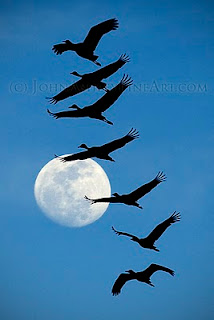
I came to this Arizona wetland last winter to photograph Sandhill Cranes. We spent two evenings running around the desert to line up a flock cranes with the rising moon. It was harder than I expected. This year, capturing cranes against the sun turned out to be easier than expected -- but I still had to scout for two days to find the best location.

First, a 500mm lens attached to the D700, a cable release attached to the camera, and everything anchored to the tripod. Aiming slightly to the right of the sun, I prefocused on the expected flight path. (Hint -- it isn't infinity. That would be too easy.)

Now for the "trick." I set the D700 to "live view" and, watching the live image on the rear LCD screen, I can safely aim the camera directly into the sun. Now I just have to shield the sun with my left hand and, when the flock approaches the inferno, fire away with the remote release.

Moonlight Flight (c) John Ashley
So I never actually see the birds cross the sun. And, if their path takes them across the center of the sun, then those few birds usually just dissappear from the image. Buts the sun's constantly moving, and the birds will fly higher and lower, nearer and farther away, so it's still a matter of luck and patience.

If it's early (or late) in the day, and there is a significant amount of thin clouds, fog, or whatever, then these will act like a neutral density filter and knock the sun back for you. Plus, you'll get a nice, sharp edge around the sun. But the sun is going to roast your image on a clear day. For days like this, the camera's ISO is set as low as it will go, while aperture and shutter speed are as high as they will go.

(Side notes: I almost always shoot wide open, so I seldom have problems with dusty sensors. Stopping the lens all the way down, however, was an ugly, ugly awakening. Also, stopping down past about f8 increases diffraction and decreases sharpness. In this sun example, however, soft focus can actually add to the images' "feel.")

Both images are simple compositions of cooperative Sandhill Cranes. But the mood of each image is as different as, well, day and night.


Thursday, January 6, 2011

The Eyes Have It

"Life is the movie you see through your own eyes. It makes little difference what's happening out there. It's how you take it that counts." (Dennis Waitley)

Desert Eyes (c) John AshleyThe Smithsonian National Natural History Museum in D.C. is on my bucket list, and has been for many years. But for now, the Arizona-Sonora Desert Museum near Tucson is my all-time favorite. From a trip there a few days ago, I put together a little reminder about what is probably the most important rule in wildlife photography. I'll give you a hint -- it has to do with eyes.

If your subject's eyes are visible, they should be tack-sharp in 99% of all situations. There's probably 1% of times when you can break this rule, but I can't think of a single example at the moment -- that's how rare it is for a good photograph to have blurred eyes visible.

Recognize anyone in the photo? Here's a few hints. There are 14 birds and a mammal, a fish, a reptile and an amphibian. Among the birds there are three different owls, a hawk, a falcon and a hummingbird. Some of these are pretty hard. If you can identify half, then you're doing pretty good. If you get more then half, you are a biologist -- go back to work.

Give up yet? Answers below.

From top left to bottom right: Harris' Hawk, unidentified fish, White-winged Dove, black-tailed prairie dog, Scrub Jay, lizard, Costa's Hummingbird, Great-horned Owl, parrot, Screech Owl, Barn Owl, Black-necked Stilt, Band-tailed Pigeon, female Cardinal, Prairie Falcon, frog.

.

Saturday, July 10, 2010

Challenge Your Creativity

"I can teach technique, but I can't teach vision." (Mike Cindric)
"Photo gear is good, but vision is better." (Chase Jarvis)

The local art museum recently asked me to write up a brief description of my photography. Hmmm. It sounded easy enough at first, but it became exponentially harder the closer I got to writing. Sort of like describing your life in three paragraphs or less.

Huckleberry Moon (c) John AshleyBut I did it. I boiled photography down to one sentence, and then backfilled with three paragraphs of fluff. I'll fluff it up even more for you.

(My opinions are not intended to bash those camera owners who will feel, well, bashed. Rather, I think this way in order to challenge to myself to hone my own photography. I want to dig deeper and make better images, and I don't want my work to look like everyone else's.)

So, here goes...

As a medium, photography spans a wide range of merit, from a vacation snapshot to an Ansel Adams creation. In this sense, I believe that there are many people who take pictures but only a few photographers who create photographs. And I'm not talking about Photoshop creations. It's a creative imagination behind the lens that makes a few photographers stand apart from the ubiquitous copycats.

Let's say that I wander around in Glacier Park until I find a "pretty" scene -- this will require 2 to 3 seconds. I choose a pleasing composition, carefully select my camera settings (manual, always!), and wait for the best light. But when I press the shutter, I am taking a copy of something that is already "pretty." In this case, I'm just a technician, and there are thousands of technicians with cameras out there. Not much different than some guy pressing the button to Xerox a glossy calender.

In some cases, this is where I begin the image making process. But in many cases, this is where a lot of self-described "photographers" end their efforts. I see these guys over and over at art shows. Oh look, yet another "picture" of flowers in front of Mt. Reynolds in evening light. Gag me with an Instamatic.

Pretty? Sometimes. Original? Not in the least.

I don't understand how some people claim the "photographer" title, just because they can point a camera and press a shutter. A moderately bored orangutan can do that. We can do better, fellow humans. We must, or photography will continue down the slippery slope towards boring irrelevance, the rejected spam of the art world.

One local "photographer" (his claim, not mine) appears to "take" every picture with a 50 mm lens from a standing position, and then whines about digital hurting "real" photography. Well, I believe that a "real" photographer should be able to create compelling images with digital, film, wet plate, pinhole, or even a cell phone. The image depends on how the brain cells are used, not the kind of camera.

Another photographer I cross paths with apparently finds images in photography magazines, and then drives around the country to copy them exactly. Shaft of light in slot canyon? Check. Sunrise in Tetons? Got it. Lighthouse on California coast? Got that, too. There's not a single image in his booth that hasn't been taken and published by a thousand others before him. Not one faint flicker of originality.

On the other hand, I recently met a high school photographer named Alex, and some of his early images are more creative and original than many of the examples above. I always tell aspiring young photographers to go ahead and "take" the easy picture. But that's where they should begin, not end. Keep working it, changing it, and sometimes you'll end up with something rare -- an original photograph! Something that isn't in every other portfolio (and art fair booth) out there.

(Don't even get me started on the so-called "game farms." If your idea of creativity involves forcing incarcerated animals to perform for you then, in my humble opinion, you don't even deserve a camera. Your dollars are creating a demand that forces wild species to live their lives in cages, and you should be strung up by your camera strap. Enough said.)

Like I said at the beginning, this is my own personal challenge and a goal that I often miss. Some days, I only manage to "take pictures," and I'm a so-called full-time professional. I try not to put too many of these pictures out in public view. Instead, I try to keep working an idea until I get to something original, or until I give up.

Chief Mountain Moonrise (c) John Ashley
Okay, a few examples.

On the east side of Glacier Park, Chief Mountain stands apart from the rest. I watched the moon rise past Chief Mountain a few times, and took some pictures. But my images never did justice to the real live spectacle, so I kept mulling it over. Finally, I experimented with a few nights of interval photographs as the full moon cruised silently past Chief. That was it. My final image is not a top seller for me, but in my mind I finally captured a bit of the spirit of the vision quests that the Blackfeet Indians seek from this mountain top.

This photograph was created 20 years after "taking" my first "picture" of the full moon behind this mountain.

Another example. I spent a few years monitoring Bald Eagle territories in Glacier Park. I watched eagles catch fish and ducks, but I'd never seen a photograph that did justice to the skill involved. I pondered, how can I photograph eagles in a way that shows what they must do just to survive? After the image came into focus in my mind, we set about in a canoe, photographing the resident pair of eagles on a small lake.
Eagle Talons (c) John Ashley
It took three months, off and on, to get the "Eagle Talons" image out of my head and into my camera. This photograph is one of our top sellers because people have never seen anything like it. Neither had I, before developing it in my mind.

One more moon example. A lookout friend tried to describe a full moon night in a fire lookout, but couldn't find the words. So I set about creating a visual description. I picked Huckleberry Lookout, looked up the azimuths and transects for several nights around the full moon, and started drawing lines on a map. To make the moon look huge, I had to make the lookout small, so I needed to be miles away from the mountain. I started hiking.

Three nights moonlighting (c) John Ashley. Click to see final results.

On the first evening, a cloudy moon rose to the right of the lookout. So I drove back the next night and changed my location. This time, the moon climbed the ridge and just missed to the left. Rats! So I returned the third night and moved the camera location again. This time it worked. From the first two nights, I learned to anchor my tripod better and shorten my interval. The final, edited photograph at the top of this page -- a photo that I created in my mind before creating it in my camera, many months later.

For two years now, I've been working on a moonrise panorama over yet another mountain. Still not good enough. Still trying -- this one, and a head full of other images that are still just ideas.

"Taking pictures" is easy. About all it takes is opposible thumbs. "Creating photographs" is much harder -- not for technical reasons, necessarily, but because it requires you to think. It requires imagination.

Again, I'm not saying that my images are better than others', or that creative photography necessarily sells better than the repetitious "pretty pictures." What I'm saying is that we should work hard to create our own niches, to be a little different. I don't always succeed, but at least I try.

And if I can succeed from time to time, then obviously you can too.

Behind the brain cells: If my words are less than convincing, listen to a much more eloquent version from guru David "AKA Strobist" Hobby at The Candid Frame podcast #98.

Behind the pinhole: If you need a little inspiration, the quote at the top of this entry is from the website of one of my favorite photographers, Stu Jenks down in Tucson, Arizona. Not only is he a creative photographer and musician, but Stu is also one of the best writers I know. His business card identifies him as, "Nocturnal Photographer, Daytime Writer." Damn, sure wish I'd have come up with that before he did. Should I just copy his creative words?

Sunday, December 21, 2008

10 Holiday Photo Tips

"Advice is judged by results, not by intentions.” (Cicero)

1. Edit later – not while the wrapping paper is flying. Don’t hold back on how many photos you take. But when life settles down again, be sure to do a thorough delete (too blurry, too dark, etc.) and don’t give in to the temptation to keep everything.

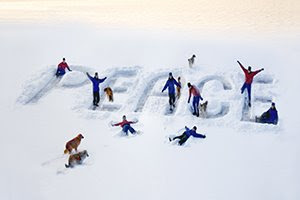
'Peace' (c) 2009 John Ashley2. Avoid taking pictures from a standing position – especially photos of pets and children! Get down on the floor so that your camera is at their eye level. For a wide view of the scene, try standing on a chair and photographing downward. Because we spend most of our days looking at the world from a standing position, changing the camera angle up or down will almost always make the photo more interesting.

3. Try to include at least one medium-range and one close-up portrait of every person present on Christmas morning. If you can make a habit of this, after a few years you’ll have a wonderful collection of year-to-year photos of the people who mean the most to you. And if you really stick to it, you’ll eventually end up with great collage material.

4. It can be hard indoors, but try to keep the clutter out of your backgrounds. When positioning yourself to take a photo, be aware of how the background might change if you moved just a skosh left or right.

5. Or go the other way – use the background to make funny photos. Catch Aunt Tracy standing in front of the wreath and she'll look angelic. Just don’t tell Uncle John that you’re lining him up in front of the deer antlers.

6. Look for variety. Think of your holiday as a movie. It starts with a wide scene, then a medium, and eventually a close-up. Most people are stuck in medium when it comes to photographs. Look for details in a plate of cookies, wide scenes full of wrapping paper shreds, etc.

7. If you live in snow country, try taking a photo from outside looking in through a window. Set your color balance to "daylight" and you'll get a warm orange interior surrounded by a cool blue exterior. Wait until the blue dusk light is one or two f-stops less than the light inside. Be sure to bracket -- and make sure it’s a window to your house.

8. If venturing outside for very long, try keeping your camera and flash batteries in a warm pocket until you reach your destination and are ready to start taking pictures. (Storing batteries in the freezer is a myth. Cold kills batteries.)

9. Make sure you have more cards/film and batteries on hand than you expect to use.

10. Remember to put the camera down from time to time and enjoy the moments!

Saturday, August 30, 2008

100 Photography Tips

"There are two types of photographers: those who take pictures and those who make pictures." (Camille Bonzani)

To start you off with a bang, here's 100 free tips on digital photography, courtesy of your neighborhood camera store (if you happen to live in New York City). If you still have questions, email me. Don't know if I can answer them, but it's always fun to get unexpected email, isn't it?